The English language is a living thing...
...constantly evolving to adapt to the ever-changing world around it. This is why it has become the language of many workplaces in the 21st century, as well as the language of business and IT.
However, English is a language which started to form in the 5th century, when Germanic tribes, the Angles, Saxons and the Jutes emigrated to Britain At that time, the people of the British Isles spoke Celtic languages, which are still in evidence today, as Welsh, and Scottish and Irish Gaelic, amongst others. In addition, the English language has been heavily influenced by Latin and French, through Roman, and then later, French rule.
Therefore, the language has passed through stages of development, classified as Old English, Middle English, and Modern English, which brings us up to the present day.
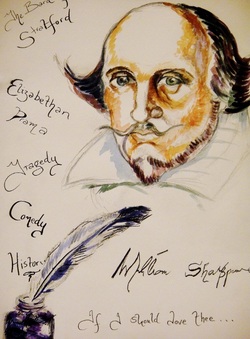
The playwright William Shakespeare is seen as a major contributor to the development of Modern English. Even so, it is still difficult to understand the English that he wrote back in the 16th and 17th centuries.
This is because in every age, language makes references to the culture that surrounds it. As culture changes, so does language.
WORDS
Words have been defined as 'the smallest units of speech that can stand by themselves' (Leonard Bloomfield (linguist), 1926).
However, Ralph Waldo Emerson, the American 19th century writer was in no doubt about their role in the bigger picture: 'Watch your thoughts, for they become words. Watch your words, for they become actions.
Watch your actions, for they become habits. Watch your habits, for they become character. Watch your character, for it becomes your destiny.'
Finally, it is worth reflecting on the wisdom of Humpty Dumpty, in Lewis Carroll's 'Through the Looking Glass' :
'The question is,' said Alice, 'whether you can make words mean so many different things.' 'The question is,' said
Humpty Dumpty, 'which is to be master - that's all.'
However, not all words have the same role to play...
...check out the site daily for useful information about words and how we use them in the English language.
However, English is a language which started to form in the 5th century, when Germanic tribes, the Angles, Saxons and the Jutes emigrated to Britain At that time, the people of the British Isles spoke Celtic languages, which are still in evidence today, as Welsh, and Scottish and Irish Gaelic, amongst others. In addition, the English language has been heavily influenced by Latin and French, through Roman, and then later, French rule.
Therefore, the language has passed through stages of development, classified as Old English, Middle English, and Modern English, which brings us up to the present day.
The playwright William Shakespeare is seen as a major contributor to the development of Modern English. Even so, it is still difficult to understand the English that he wrote back in the 16th and 17th centuries.
This is because in every age, language makes references to the culture that surrounds it. As culture changes, so does language.
WORDS
Words have been defined as 'the smallest units of speech that can stand by themselves' (Leonard Bloomfield (linguist), 1926).
However, Ralph Waldo Emerson, the American 19th century writer was in no doubt about their role in the bigger picture: 'Watch your thoughts, for they become words. Watch your words, for they become actions.
Watch your actions, for they become habits. Watch your habits, for they become character. Watch your character, for it becomes your destiny.'
Finally, it is worth reflecting on the wisdom of Humpty Dumpty, in Lewis Carroll's 'Through the Looking Glass' :
'The question is,' said Alice, 'whether you can make words mean so many different things.' 'The question is,' said
Humpty Dumpty, 'which is to be master - that's all.'
However, not all words have the same role to play...
...check out the site daily for useful information about words and how we use them in the English language.